Context
For my Product Management Capstone at Carnegie Mellon University Academy PT, I proposed a feature for HiBob's ATS: a Candidate Comparison view. HiBob is loved for its people-first UX, but its recruitment module lacks deep comparison tools. Hiring managers still fall back on spreadsheets and gut feel when it matters most — choosing between finalists.
The three phases of recruitment
Before proposing anything, I mapped how teams actually hire. The workflow splits into three phases — and the pain is not evenly distributed.
Attract
Sourcing talent and writing job descriptions to bring in qualified candidates. Recruiters screen applications and shortlist for interviews.
Evaluate
Structured interviews across multiple stages — technical, cultural, behavioural — while recruiters coordinate schedules and chase feedback.
DecideBOTTLENECK
Comparing finalists, synthesising feedback, reaching consensus. This is where deals are won or lost — and where the tooling breaks down.
Research
I interviewed six people — five recruiters (2 to 10 years of experience) and one hiring manager — to validate that Phase 3 was the real bottleneck. Every single one confirmed the same thing: they had lost top candidates because internal decision-making took too long.
100%
Rely on manual workarounds (Excel, Slack, Notepad)
7.6
Average comparison difficulty (out of 10)
>2h
Per recruiter, weekly, chasing feedback
“If the system automatically placed them side by side, it would be much easier.”
Two consistent problems surfaced across interviews: high cognitive load when weighing candidates across dimensions, and no shared comparison layer — feedback lived in scattered profiles, Slack threads, and personal notes.
The solution — in three parts
Side-by-side matrix
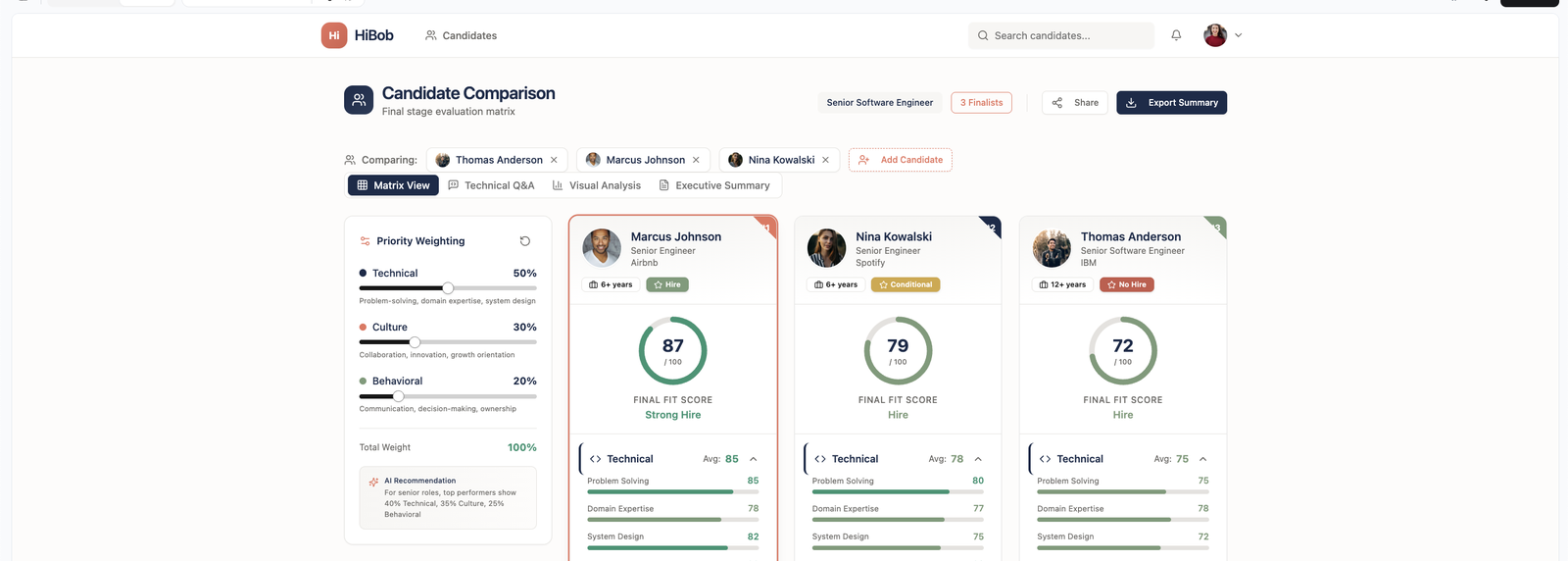
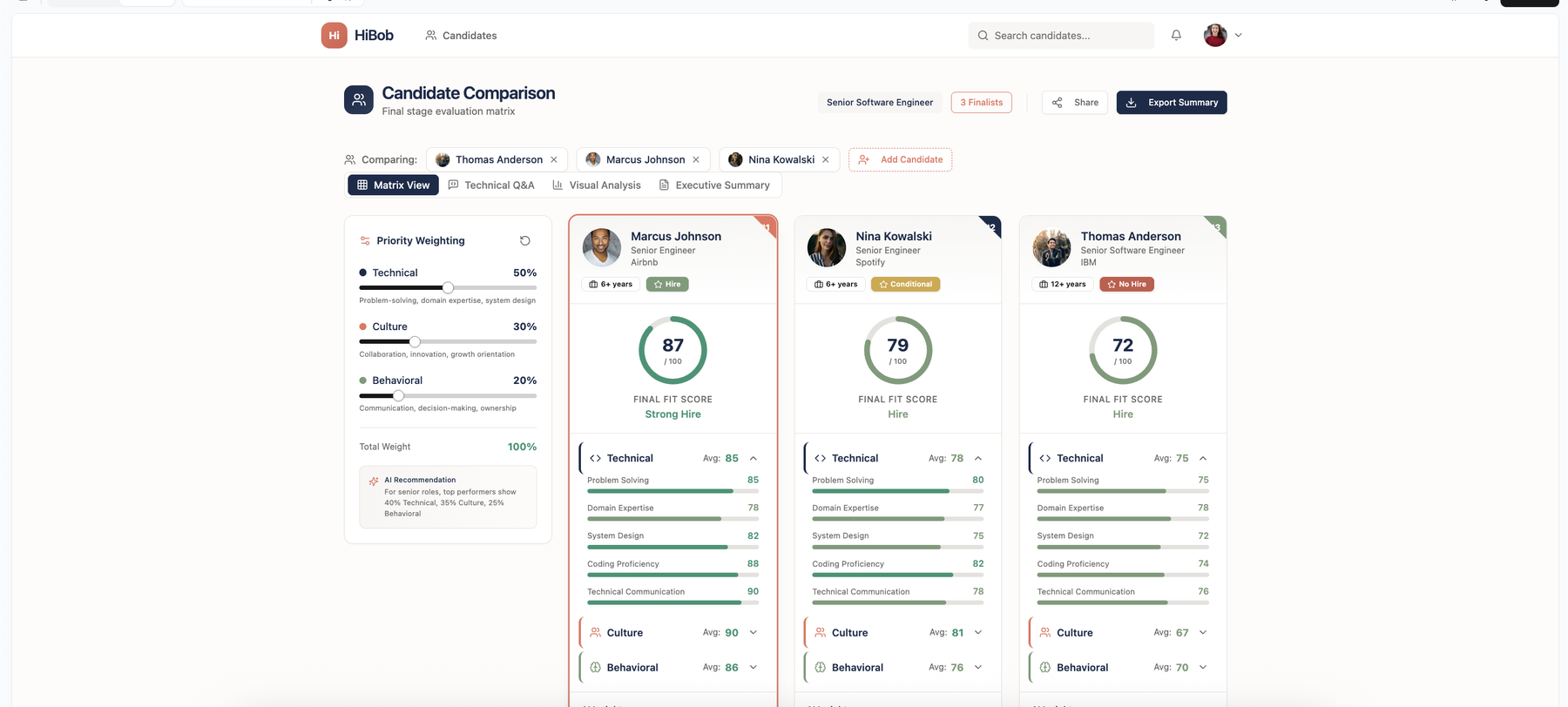
Compare finalists on identical interview modules (Technical, Culture, Behavioural) in a single grid. No more tab switching.
Weighted scoring per role
Users assign weights to each module (e.g. Technical 50%, Culture 30%, Behavioural 20%) so the score reflects what actually matters for the role — not a generic average.
AI-powered summaries with bias guardrails
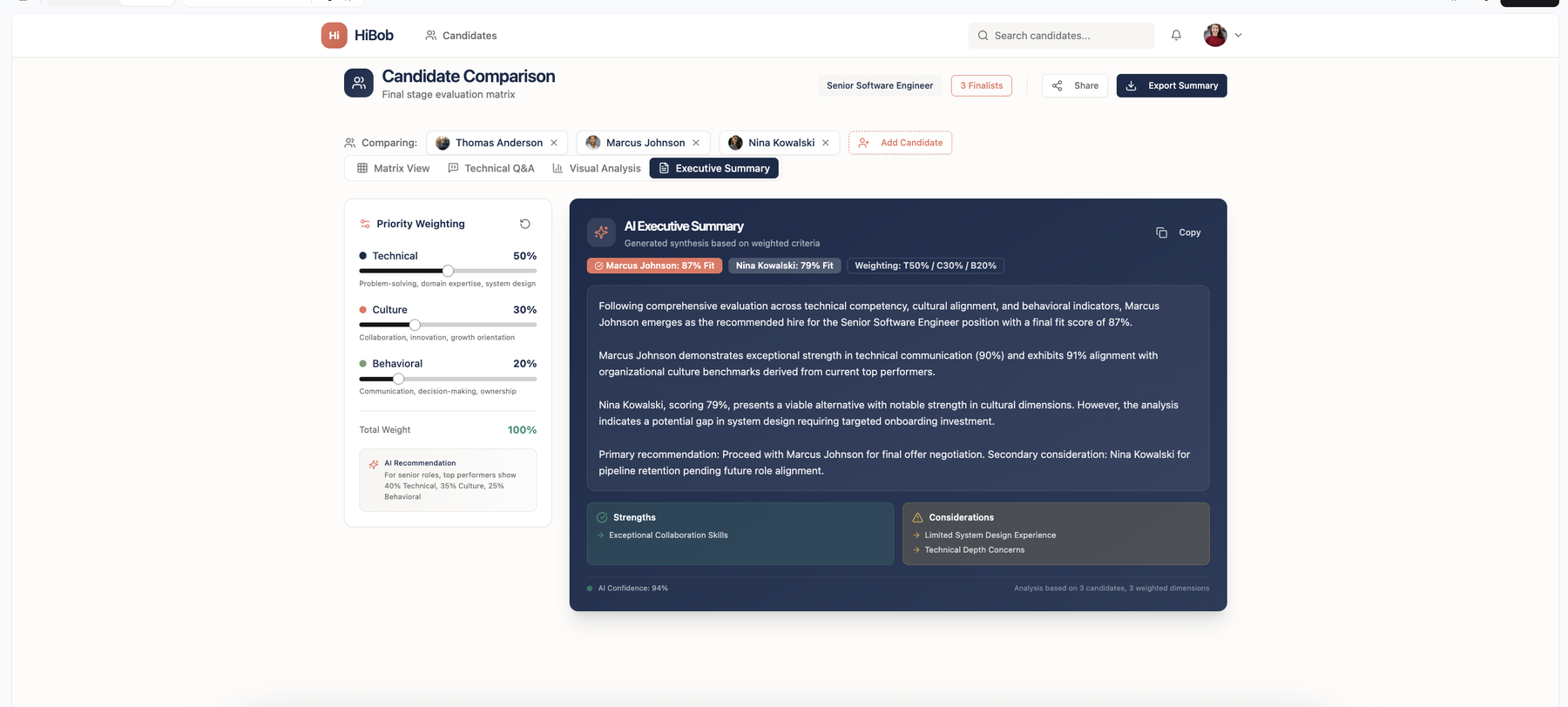
The AI synthesises interview notes into a short executive summary. Critically, it never sees name, photo, location, years of experience, university, or company brand — decisions land on merit, not proxies.
The prototype
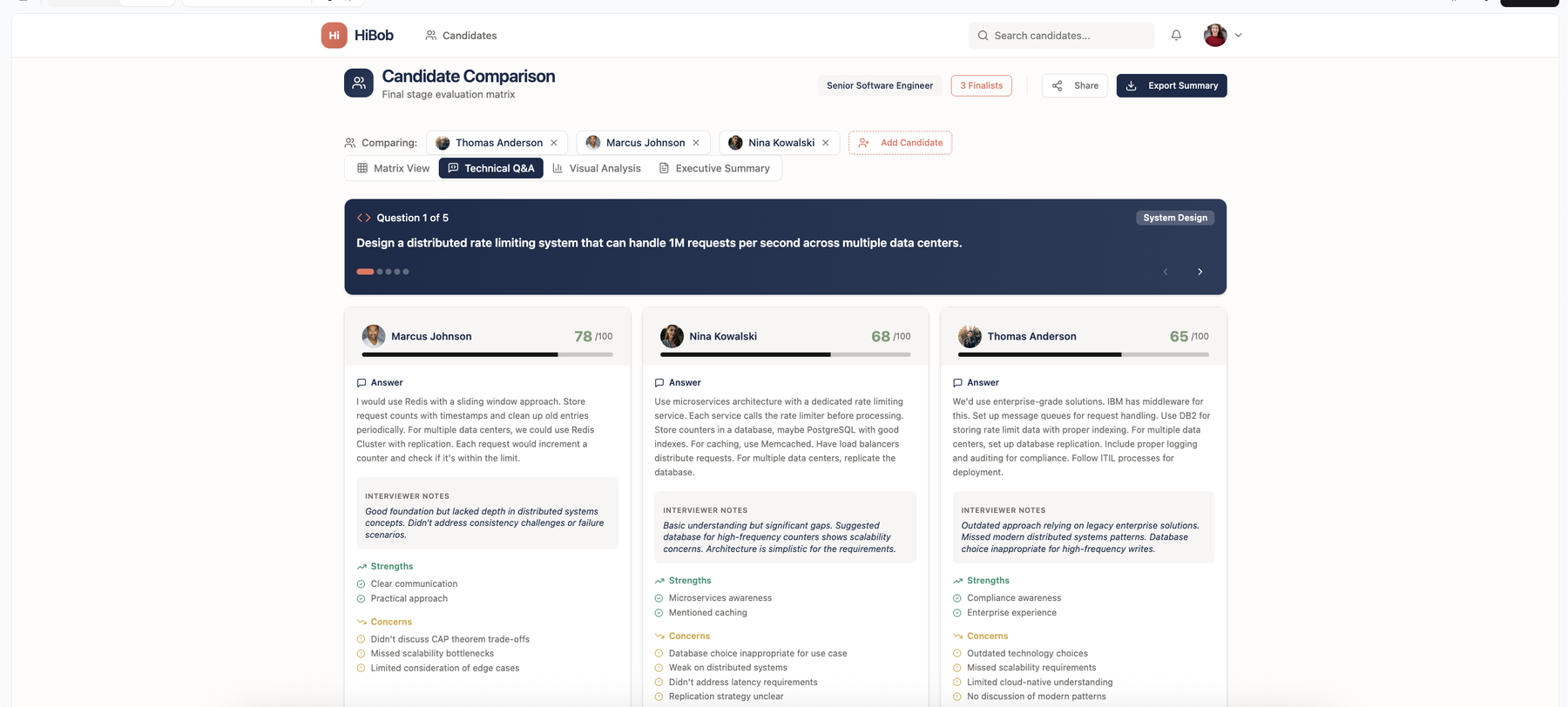
I built a working prototype in Base44 to pressure-test the flow with the same recruiters I interviewed. Three views, one story.
Concept prototype built as a CMU Product Management Capstone. Not affiliated with or endorsed by HiBob.
The business case
For a lean team — two recruiters and one hiring manager — 2 hours per person per week adds up to nearly two full work months lost annuallyto manual comparison. That's a margin problem, not a workflow problem.
CLOSING SLIDE
Manual comparison is costing you more than time.
Top candidates gone to competitors. Manual workarounds creating compliance risk. The question isn't whether you can afford this solution — it's whether you can afford not to.
Competitive angle
Benchmarking Greenhouse, Lever and Workable showed the same gap. Scorecards yes, side-by-side weighted comparison with AI synthesis — no.
For HiBob, this is category-defining, not incremental. It ships as a native extension of the existing ATS, so the moat is depth of integration — not features competitors can bolt on in six months.
What I’d do next
MVP with 20 design partners
Ship the matrix view + weighted scoring first, without AI. Validate the ranking model with real hiring loops before layering intelligence on top.
Measure decision-to-offer time
The north-star metric isn’t adoption — it’s how many days shorter Phase 3 becomes. That’s what protects candidates from competing offers.
Layer in bias detection
Once the summary engine is stable, flag inconsistent scoring across interviewers as a coaching signal — not a blocker.